Gym lockers fail for one reason: moisture. A locker room handling 400 showers a day is a permanently saturated environment, and the failure mode is not cosmetic — it is a door that swells, a hinge that seizes, and a lock that stops turning while a member is standing in a towel.
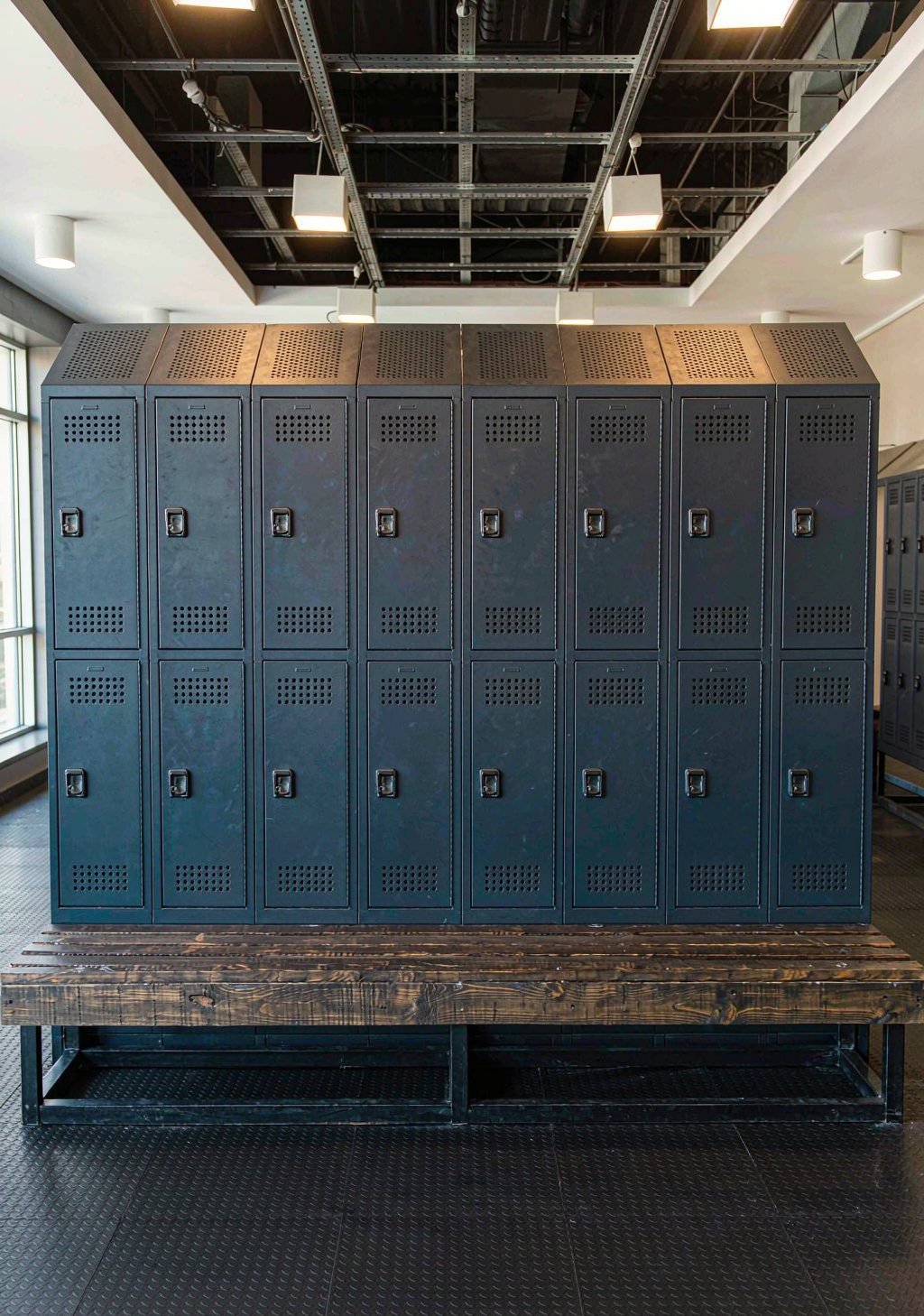
Everything on this page is about keeping steel serviceable in that environment, at the capacity a commercial gym actually needs.
Why standard lockers do not survive a wet changing room
Cold-rolled steel with a polyester coating is fine indoors and dry. In a shower room, three things happen:
- Edge corrosion. Coating protects flat faces; cut edges and hinge holes are bare metal. Moisture attacks there first, and rust creeps under the film from the edge inward.
- Trapped moisture. A solid-door locker in a humid room holds a micro-climate. Chlorine and sweat residue stay on the steel.
- Salt and chlorine attack. Pool-adjacent changing rooms are the harshest version of this — chloramine vapour eats standard coatings in two to three seasons.
The fix is not thicker paint. It is substrate, ventilation and detailing specified together.
Specifying for humidity: four decisions
| Decision | Dry gym / studio | Wet changing room / poolside |
|---|---|---|
| Substrate | Cold-rolled (SPCC), 0.6 mm body | Galvanized (SGCC) — the zinc protects cut edges |
| Coating | Polyester, 60–80 µm | Epoxy-polyester, 80 µm+, with anti-bacterial additive |
| Doors | Louvers on door and sides | Full louver pattern plus open base plinth for airflow |
| Hardware | Standard cam lock | Stainless or nylon-coated hinges and fixings |
On poolside installations we also recommend a sloped locker top or a full-height carcass with a closed canopy. Flat tops collect water and dust, and nobody ever cleans the top of a locker bank.
Capacity: how many lockers does a gym actually need
The number that matters is peak concurrent occupancy, not total membership. A 2,000-member gym with a peak of 60 people in the changing room at once needs capacity for the peak, plus a margin for peak-to-peak overlap at class changeover.
| Membership profile | Peak concurrency | Suggested capacity | Configuration |
|---|---|---|---|
| Studio / class-based | 20–30% of class size | 1.2× peak | Double tier |
| Commercial gym, day passes | 8–12% of membership | 1.0× peak + 10% | Triple tier for day users, double for members |
| 24/7 access gym | 4–8% of membership | 1.0× peak | Double tier, RFID |
| Competition pool | Rotation every 45–60 min | 1.0× peak | Single tier for bags, plus bench-top cages |
Triple tier is how operators add capacity without adding floor area — but a 560 mm door does not take a gym bag standing upright. Use triple tier for day-pass and casual users who are storing shoes and a jacket, and keep double tier for members arriving with a bag.
Locks: matching the lock to the membership model
- Padlock hasp — cheapest to run, zero admin. The member brings the padlock. Works for budget and 24/7 sites. Downside: cut padlocks and abandoned locks accumulate.
- Coin or token — no database, no front-desk work. Standard for public pools and casual-use facilities. Budget for the jams: coins and bent tokens are the number one maintenance call.
- RFID / card — ties to the membership system, no keys to lose, and lock-out events are logged. Specify the reader protocol and card frequency before the doors are punched, because retro-fitting is where projects slip.
- Digital keypad — decent middle ground for studio chains. Battery replacement is the real operating cost.
Whatever you choose, order it factory-fitted. A door punched for one lock type rarely takes another cleanly.
Layout: the mistakes that get built in
- No bench depth. A 450 mm locker with a bench in front needs 900 mm of clear circulation behind the bench. Below that, two members cannot pass.
- Ignoring the wet/dry split. Lockers placed inside the shower zone corrode first and are also a privacy problem. Put a partition in the design, not in the complaint log.
- Flat tops used as storage. Specify a sloped or closed top if the cleaning contractor is not going to reach it.
- No plinth. Floor washing water sits under the base rail. A 75–100 mm plinth or glides lifts the carcass clear.
Related: general metal locker specifications and staff lockers for gym employees.
Frequently asked questions
Galvanized or stainless steel for a pool changing room?
Galvanized with an epoxy-polyester coating handles most chlorinated indoor pools. Stainless (304) is the right answer for coastal or high-chloramine environments, but it costs two to three times as much and still needs the right grade — 304 fails in salt air, 316 is required.
How do you stop the smell inside lockers?
Ventilation and airflow, not deodoriser. Louvers on the door and both sides plus an open base give the interior a convection path. Sealed boxes trap damp kit.
Can we replace lockers bank by bank to avoid closing the changing room?
Yes, and it is worth planning that way. Order the full quantity in one production run so the coating batch matches, then ship and install in phases. Colour drift between production runs is visible under changing-room lighting.
What is the lead time for a gym refit?
Production runs 7–15 days after drawing approval and deposit. Sea freight adds 18–25 days to the US West Coast, 28–35 days to Europe. A refit with a fixed reopening date should allow 8–10 weeks door to door.
Send us the changing room plan
Give us the floor plan, the peak occupancy figure and the pool or shower situation. We will come back with a configuration and a loading plan. Request a quote.