Staff lockers are specified differently from student or gym lockers, because the user is an adult who is at work for eight hours and whose belongings include a laptop, a phone, a change of clothes and sometimes a uniform that has to go home clean.
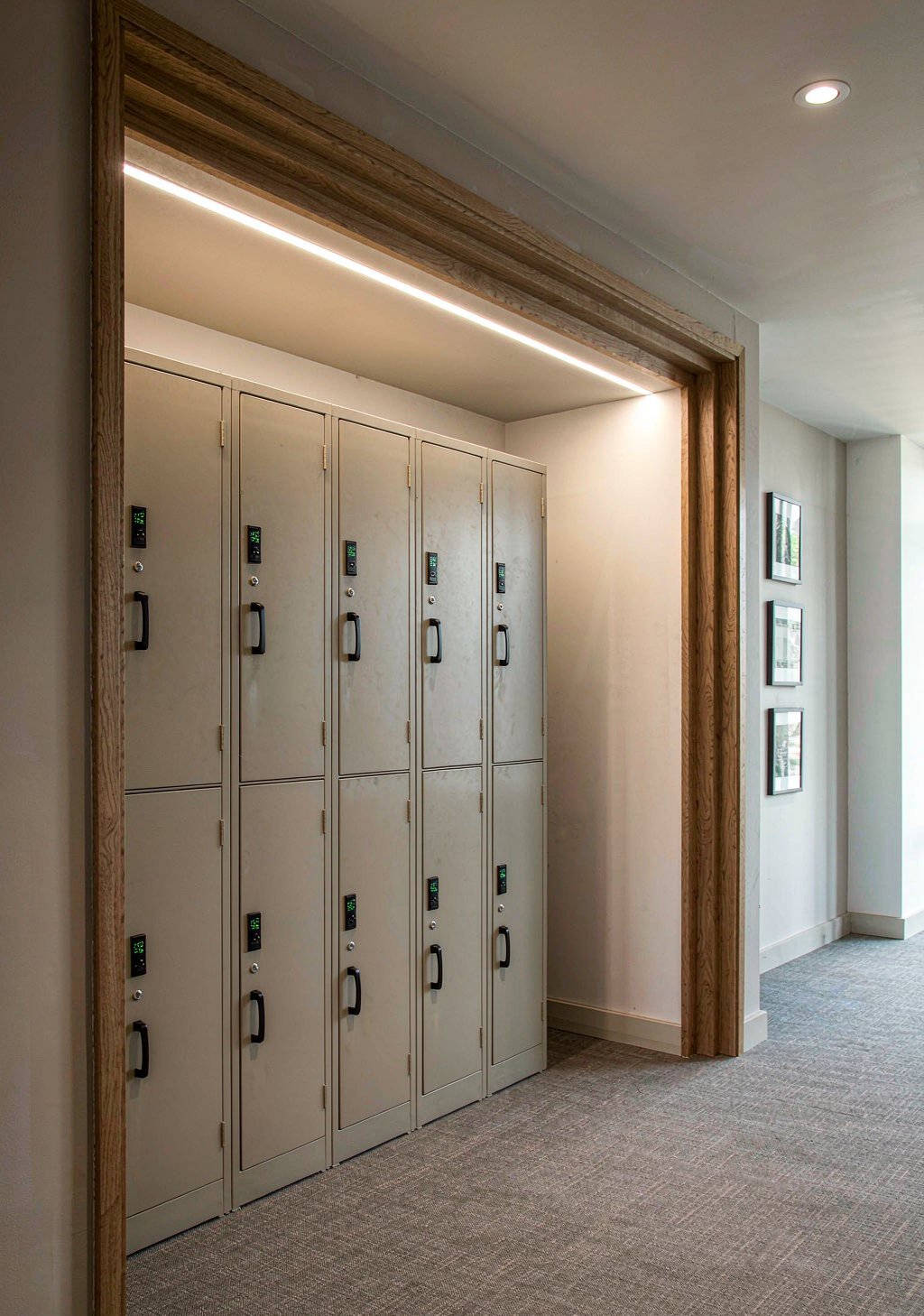
Get them wrong and you hear about it every week for ten years. Get them right and nobody mentions them again.
Full-height or compartment: the first decision
| Configuration | What it stores | Best for |
|---|---|---|
| Full-height single tier (1800 mm) | Hanging clothes, a bag, a helmet, boots | Shift workers, factory and site staff, anyone changing in and out of uniform |
| Two-door compartment (upper + lower) | Work clothes below, personal items above | Clean/dirty separation — food production, healthcare, labs |
| Four-compartment (2×2) | Personal items only, no hanging | Office and co-working, where staff keep a jacket and a bag but do not change |
| Bench-integrated (Z-tier) | Sitting and changing in one footprint | Where floor area is tight and a separate bench would block circulation |
The clean/dirty split is the specification most often missed. If staff take a contaminated uniform home, the locker has to physically separate it from the clean change of clothes — a single compartment cannot do that, and staff will improvise with plastic bags.
Power inside the locker
Charging is now a standard requirement, not a luxury. Two options, and the choice affects how the lockers are wired on site:
- Per-locker socket with a USB outlet — each locker has its own switched socket. Requires a power feed into the bank and a licensed electrician on site. Most flexible, highest install cost.
- Central charging strip with a single feed — one supply per bank, sockets distributed internally. Cheaper to install, but all lockers share one circuit and one breaker.
Either way, specify a cable pass-through grommet in the door or side panel. Charging a phone through a door gap damages the cable and eventually the door seal. And confirm with the client’s facilities team whether the sockets must be RCD-protected — in most jurisdictions they must.
Shift work: allocating lockers to more people than lockers
A factory running three shifts does not need three lockers per employee. It needs one locker per concurrent shift, plus a margin. Two workable models:
| Model | How it works | Trade-off |
|---|---|---|
| Assigned lockers | Each employee has a permanent locker | Simplest administratively, highest unit count |
| Hot-desking by shift | Locker allocated per shift; contents cleared at handover | 30–40% fewer lockers, needs a clear-out policy and enforcement |
| Day lockers + assigned | Assigned for permanent staff, day lockers for contractors and agency workers | Handles fluctuating headcount without over-buying |
If the client wants hot-desking, the lock must support it: a coin or RFID lock with a time-limited release is easier to enforce than a key that gets copied and passed around.
Office and co-working installations
In an office the locker is a personal storage unit, not a changing room. Priorities shift:
- Shallow depth. 400–450 mm is enough; deeper cabinets eat circulation space and get used as a dumping ground.
- Clean lines. A flat door with an integrated lock and no visible hasp. In a client-facing area the locker is furniture.
- Acoustic consideration. Bank lockers in an open-plan office act as a drum. Door buffers and soft-close hinges are worth specifying.
- Naming and allocation. A printed or engraved name strip on each door saves the facilities team a weekly email thread.
Security levels, honestly stated
A steel locker is a deterrent, not a safe. It stops opportunistic theft and keeps honest people honest. It will not stop someone with 20 minutes and a pry bar. If the client is storing laptops overnight in an unstaffed building, the correct answer is a locker inside a secure room, not a heavier locker.
What we can do is remove the easy attack routes: recessed locks instead of protruding hasps, welded frames instead of rivets, and a door stiffener so the panel cannot be flexed away from the lock bolt.
Frequently asked questions
Can lockers be supplied with a coat rail and shelf?
Yes. Full-height lockers take a top shelf and a rail as standard options. Specify the rail height — a rail set for business suits is too high for overalls and boots.
Do you supply the electrics or just the cut-outs?
We supply the locker with the socket and internal wiring terminated in a junction box at the base of the bank. Final connection to the building supply is by the client’s electrician and must be signed off locally.
What about ventilation for damp workwear?
Louvers on the door and a ventilated top or base. Sealed steel plus damp overalls produces a smell that staff will complain about within a month.
Can we add lockers later?
Yes if the original bank was designed with the expansion in mind. Order the full run in one production batch to keep the coating colour matched, then ship in phases.
Is a name plate included?
Card holders are standard. Engraved or printed name strips are available and worth it above 50 units — it eliminates the handwritten-label look.
Specify a staff locker run
Tell us the headcount, the shift pattern and whether power is needed inside. We will size the run and quote it. Request a quote.