A metal locker is a simple product with a surprising number of hidden variables. Two units that look identical in a photo can differ by 40% in steel gauge, hinge design and coating thickness — and that difference only shows up two years later, when one bank of lockers still closes cleanly and the other has doors that hang.
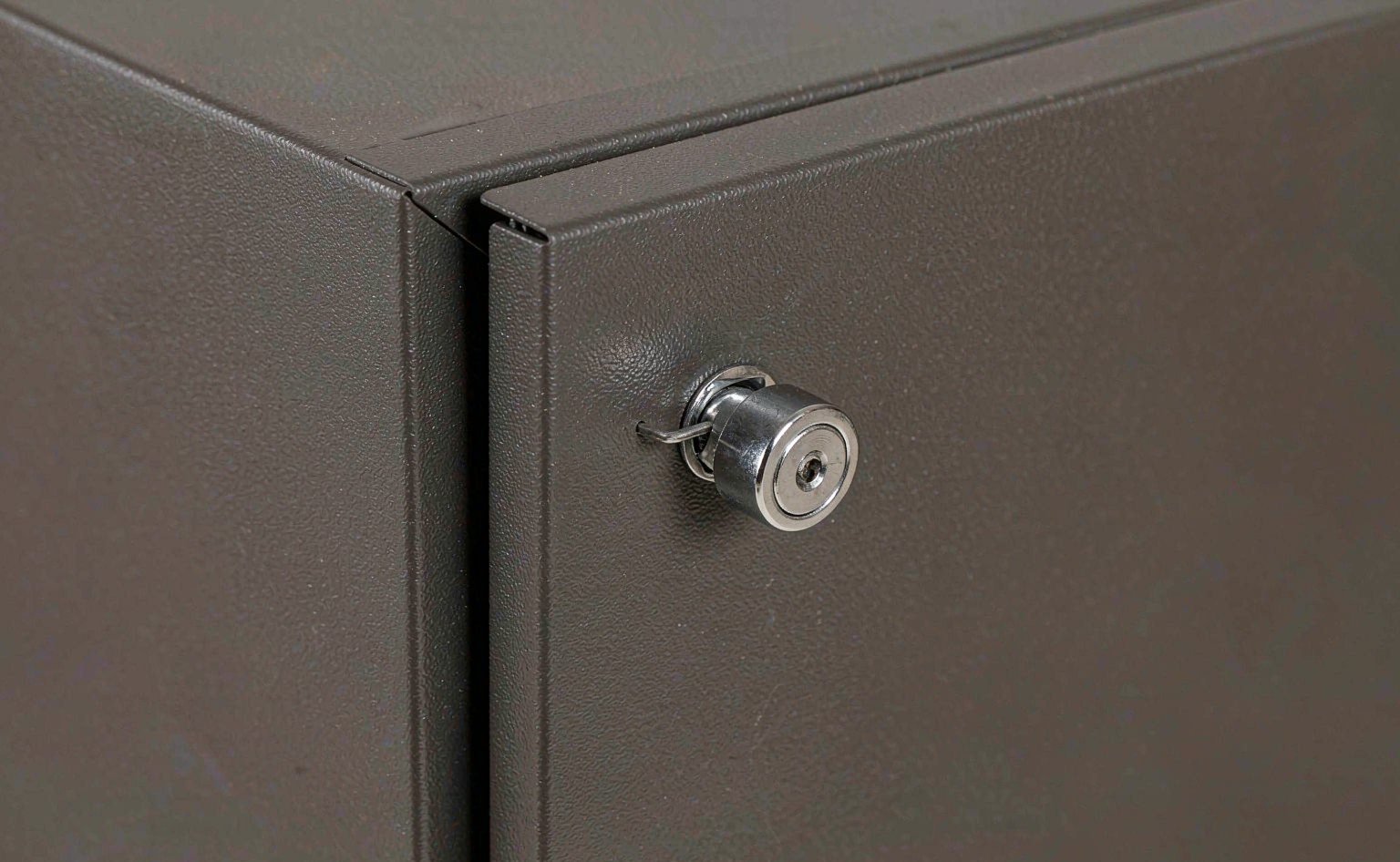
This page covers what we manufacture, how the specifications actually affect service life, and how to choose a configuration that survives the environment it is going into.
Tier configurations and where each one belongs
Tier count is the first decision, because it sets your capacity per square metre and the door height your users get.
| Configuration | Door height | Capacity per 900 mm bay | Typical use |
|---|---|---|---|
| Single tier | 1700–1800 mm | 1 | Staff rooms, hospitals, sites where users hang coats and store bags upright |
| Double tier | 850–900 mm | 2 | Gyms, schools, general staff changing — the default compromise |
| Triple tier | 560–600 mm | 3 | High-turnover facilities with short storage windows: leisure centres, day-pass gyms |
| Four / six tier | 350–400 mm | 4–6 | Helmets, PPE, tablets, mail slots — small-item storage only |
| Z-tier (locker + bench) | Two unequal doors | 2 | Where a seat is needed in the same footprint |
If you are unsure, ask what the user is storing and for how long. A gym with day passes needs capacity; a hospital staff room needs hanging height. Those two answers point to opposite configurations.
Steel gauge: what the number does and does not tell you
We build bodies from 0.6 mm cold-rolled steel (SPCC) with 0.8 mm doors as standard, and go up to 1.2 mm for high-security or heavy-abuse installations. That is the normal range for export-grade product. Anyone quoting 0.4 mm and calling it commercial is selling shelving with a lock on it.
But gauge alone is a weak specification. Three other things decide whether a locker bank stays square after five years:
- Bracing. A 0.6 mm body with a full-width top rail, base rail and rear cross-brace outperforms a 1.0 mm body with none. Ask for a photo of the inside of the carcass.
- Hinge design. Exposed pin hinges wear and squeal. Concealed or full-length piano hinges distribute load along the door edge.
- Welding versus rivets. Riveted carcasses are cheaper to ship flat-packed but work loose under repeated door slam. We weld the frame and knock down at the panel joints only.
A supplier who only talks about millimetres is quoting sheet metal. A supplier who talks about bracing and hinges is quoting lockers.
Lock and access options
| Lock type | Best for | Notes |
|---|---|---|
| Key lock (cam) | Staff, schools, single-tenant use | Master-key and key-alike systems available; budget for replacement keys |
| Padlock hasp | Gyms, industrial sites | User supplies the padlock — lowest admin burden for the operator |
| Coin / token | Public pools, leisure centres, day-pass gyms | No membership database needed; collection and jam risk to manage |
| Digital keypad | Offices, co-working, short-term rental | Battery replacement schedule matters more than the lock itself |
| RFID / card | Membership gyms, universities, corporate campuses | Integrates with the access system already on site; specify the reader protocol early |
Order the lock as a factory-fitted item. Retro-fitting an electronic lock into a door punched for a cam lock is where most access-control projects lose a week.
Finish: the part that decides how it looks in year three
All our lockers are electrostatically powder coated at 60–80 µm film thickness, cured at 200 °C. Three specification choices matter:
- Standard polyester — indoor, dry environments. The default.
- Anti-bacterial additive — clinical and food-adjacent settings. Specify it if the buying decision involves an infection-control team.
- Galvanized substrate (SGCC) — wet rooms, poolside, coastal sites. The zinc layer protects cut edges that coating cannot reach.
If a locker room sees hundreds of showers a day, galvanized substrate is not an upgrade — it is the minimum. Coating over cold-rolled steel in a permanently damp room will blister from the inside out, and no warranty claim survives that argument.
Standard dimensions
| Parameter | Standard | Options |
|---|---|---|
| Overall height | 1800 mm | 1850 / 1900 mm |
| Width per door | 300 / 380 / 400 mm | Custom |
| Depth | 450 mm | 400 / 500 mm |
| Body steel | 0.6 mm SPCC | 0.8 / 1.0 / 1.2 mm |
| Door steel | 0.8 mm SPCC | 1.0 mm |
| Coating | 60–80 µm polyester | Anti-bacterial, anti-graffiti |
| Ventilation | Louvers, door and sides | Solid door for dust-controlled areas |
| Assembly | Flat-packed knock-down | Welded unit on request |
Custom dimensions carry no tooling fee at our 50-unit minimum. If your alcove is 3,240 mm and standard bays leave a 240 mm gap, we build to the alcove — not to the catalogue.
Loading and landed cost
A 40HQ takes roughly 320–360 single-tier lockers flat-packed; double and triple tier pack denser per door but heavier per unit. We calculate container fill at quotation stage, because whether your order ships as one container or one and a half changes your landed cost per unit more than the unit price does.
If your quantity sits near a container boundary, it is worth asking whether adjusting the mix — more triple tier, fewer single — gets you a full container. On smaller orders the difference between FOB and a shared LCL shipment is often larger than the price difference between two suppliers.
Related configurations
Most projects are not pure. A single building often needs ventilated lockers in the change rooms, height-tiered units in corridors and full-height lockers in the staff area. Mixed containers are normal for us — the 50-unit minimum applies per specification, not per order.
Frequently asked questions
What is the minimum order quantity?
50 units per specification. Mixed models can share one container; the combined total determines the freight, not the MOQ.
How thick should the steel be?
0.6 mm body and 0.8 mm door suits most commercial installations. Go to 1.0–1.2 mm where the lockers face deliberate abuse — prisons, military, public transport staff areas — not simply because a thicker number sounds safer.
Can you match an existing colour?
Yes. Send a RAL number or a physical sample. In-house coating means we control the batch, so a repeat order two years later can be matched rather than approximated.
Do you supply samples?
Yes. Pre-production samples are charged and refunded against orders above 500 units.
Can lockers be anchored to the wall?
Every bank ships with wall-fixing brackets. For corridors and public areas we recommend anti-tip anchoring as standard, not optional.
Get a quoted specification
Send quantities, dimensions and the environment the lockers are going into. You get a costed proposal within 24 hours, including a loading plan. Request a quote.